The challenge
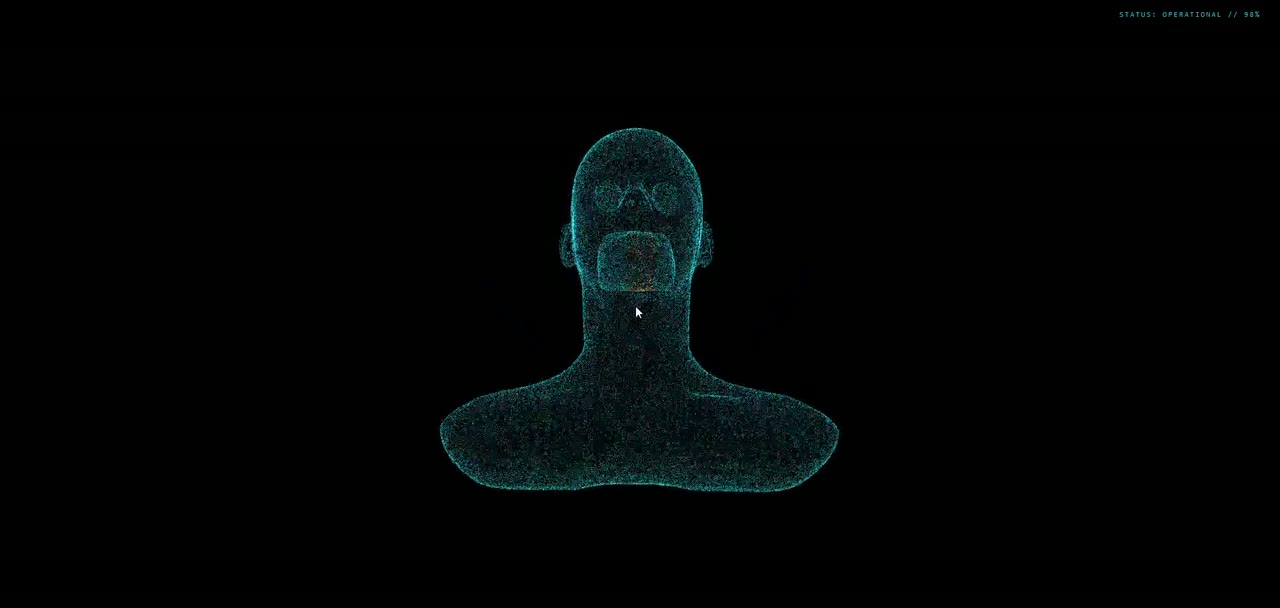
Build a convincing 3D human bust out of particles. No Blender, no Maya, no Three.js, no 3D assets: just code, projection math and a single self-contained HTML file.
The bar wasn’t “looks like a head”. It was spatial persistence: the form has to hold together from the front, the side, above and every angle in between, including the empty space of an open mouth. Most evaluations reward a resemblance from one viewpoint. We wanted structure that survives rotation.
How it failed
Under the same instructions, the attempts failed in three distinct ways:
| Failure | What came back |
|---|---|
| Generic | A human-like silhouette that passed from the front and broke as soon as it rotated |
| Geometric fallback | A triangular orb in place of a head |
| Collapse | An oval blob, or a diffuse field of points orbiting nothing |
Each one optimized for how it looked, not for whether it held together.
Why it failed
Watching the failures frame by frame pointed at the projection, not the particle count:
- Depth sorting depended on the viewpoint, so the form only worked from one side.
- The mouth was painted on as a texture, not cut out as empty space.
- The shape was checked after generation, instead of being enforced while the particles were placed.
How it was fixed
A human diagnosed each failure, and the model made one targeted change at a time: enforce the shape as a constraint field, carve the mouth out as a real void, re-project, then verify against the rotation before the next change.
The result is the film above: a bust that keeps its volume and its open mouth through front, profile, oblique and top views, recorded live as it rotates. Rotation is the evidence here, because a still image can be cherry-picked.
What it shows, and what it doesn’t
Under these conditions, the models we tested did not produce this artifact on their own. With a human diagnosing failures and directing changes, a Gemini Flash model did. The capability came from the whole loop of model, constraints, human diagnosis and verification, not from the model weights alone.
It does not show that no model can ever do this unaided. It shows how much of a first failure can be recovered when the failure is diagnosed correctly.
What’s next
The same challenge, run against several frontier models under identical constraints, with each attempt scored on the same rotation test.